

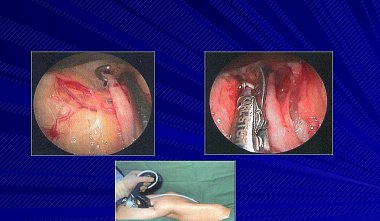
Endoscopic subfascial dissection of perforating veins in the treatment of chronic venous insufficiency of the lower extremities
Endoscopic subfascial dissection of perforating veins has been introduced at our clinic since 2001 and has been performed on 56 patients, including 45 (80.4%) with stage III chronic venous insufficiency and 11 (19.6%) with stage IV. The surgery was performed using a specialized set of instruments. Perforating veins were localized preoperatively using duplex scanning. In 12 cases (21.4%), discrepancies were observed between preoperative scanning data and intraoperative vein localization. A medial approach was used in all cases, for which we fabricated a special thigh support to facilitate the surgery. Between 3 and 7 perforating veins were treated during the surgery. Vein dissection was performed using electrocoagulation with a bipolar cautery; veins larger than 5 mm were dissected using vein clipping. It was found that standard kits do not allow for the treatment of veins larger than 6 mm in diameter. The average duration of endoscopic subfascial dissection of perforating veins was 36 ± 5 minutes. Superficial vein dissection was performed in 54 patients (96.4%) as indicated. Thanks to the use of minimally invasive technologies, the rehabilitation period was significantly easier than after traditional surgeries, with postoperative adaptation to active mode occurring as early as the first day. No purulent-septic complications were noted. There were no cases of deep vein thrombosis early after treatment. Trophic ulcers healed within 4-6 weeks after surgery with comprehensive treatment. The average postoperative hospital stay was 7 ± 2 days, and the average postoperative disability period was 24 ± 3 days. Thus, endoscopic subfascial dissection of perforating veins is a radical intervention that eliminates horizontal venous reflux. This procedure provides good cosmetic and functional results, significantly reduces the incidence of postoperative complications, and shortens the hospitalization and rehabilitation period for patients.


