

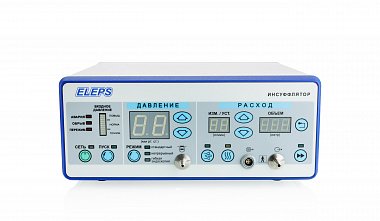
INS‑01 Insufflator with Gas Heating: Solving Insufflation Problems in Laparoscopy, Flexible Endoscopy, and Bariatric Surgery
Modern minimally invasive surgery is impossible without high-quality insufflation. The INS‑01 endoscopic insufflator ("ElePS") is a ready-made solution for the safe creation of pneumoperitoneum.
Why is insufflation needed in laparoscopy?
A laparoscopic operation, in addition to being minimally traumatic, has a feature that distinguishes it from traditional surgery — the need to create pneumoperitoneum. This is achieved by insufflating carbon dioxide into the abdominal cavity, which creates the space necessary for performing surgical manipulations. Intra-abdominal pressure is maintained at 10–15 mmHg.
Parameters of the supplied gas:
-
Low relative humidity — about 2%
-
Moderate temperature — 24–25 °C
-
High pressure — 180–5000 kPa
Important: when expanding, the gas cools. The degree of cooling depends on the flow rate: the higher the flow, the stronger the cooling.
Main complications and problems of insufflation
When performing insufflation without modern equipment, typical risks arise:
-
Patient hypothermia
-
Postoperative pain
-
Fogging of the laparoscope optics
-
Difficulties in maintaining stable pressure
-
Inaccurate gas volume control
-
Lack of effective smoke evacuation during coagulation
Insufflation in flexible endoscopy: features and requirements
Insufflation in flexible endoscopy is a method of expanding the lumen of a hollow organ (e.g., stomach, intestine) by introducing gas, usually carbon dioxide (CO₂). This provides better visualization of the mucous membrane and facilitates instrument manipulation.
In flexible endoscopy, insufflation pressure is carefully controlled to prevent barotrauma. Unlike rigid endoscopes, flexible endoscopes are less durable and can be damaged by excessive pressure.
Gas volume and pressure control
Flexible endoscopes often have automated insufflation systems that regulate gas flow according to needs.
Type of gas for flexible endoscopy
CO₂ is preferable in flexible endoscopy due to its high absorbability, which reduces patient discomfort after the procedure.
Insufflation in bariatric surgery: special requirements
Patients with obesity require an individual approach to insufflation. Key tasks:
-
Maintaining stable pressure — necessary for adequate visualization, but excessive pressure can lead to hemodynamic disturbances, especially in obese patients.
-
Gas volume control — bariatric patients often have reduced lung function, so it is important to minimize the volume of gas introduced to prevent respiratory complications.
-
Smoke evacuation — the use of electrocautery creates smoke that impairs visibility. An effective smoke evacuation system is necessary.
-
Accurate pressure monitoring — using insufflators with feedback to maintain set pressure.
Special needs of bariatric insufflation:
-
Low-flow insufflation (minimizing the volume of gas introduced)
-
Modern smoke evacuation systems
Ready-made solution to insufflation problems — INS‑01 insufflator (INS‑01‑1)
The INS‑01 endoscopic insufflator with gas heating ("ElePS") systematically solves all the problems listed above.
What the INS‑01 insufflator provides:
-
Gas outlet heating:
at flow rates up to 20 L/min – 37 ± 3°C;
at flow rates above 20 L/min – no more than 40°C. -
Inlet pressure indication:
from 0 to 0.3 MPa with 0.1 MPa resolution;
from 0.3 to 0.65 MPa with 0.05 MPa resolution. -
External smoke evacuation unit control
-
Forced gas supply system until the set pressure is reached
-
Pressure relief system when pressure exceeds the set value by 3 mmHg for 10 seconds
-
Audible vacuum alarm in the abdominal cavity with activation level no more than -3 mmHg
Quick guide to using the INS‑01‑1 "ElePS" insufflator
Step 1. Power-on and standby mode
Set the "POWER" switch on the rear panel of the insufflator to position "I". The "POWER" indicator on the front panel will light up orange. This is standby mode — the insufflator can remain in this state indefinitely.
Step 2. Switch to operating mode
Press the "POWER" button on the front panel. The indicator will turn green. The "INLET PRESSURE" indicator reading should be in the "NORMAL" sector.
Step 3. Pressure setting and forced supply
Set the desired pressure using the decrease or increase buttons, monitoring the value on the "PRESSURE" digital display. If necessary to accelerate abdominal cavity filling, turn on the "FORCED GAS SUPPLY" mode. This mode operates briefly — until the actual pressure reaches the set value.
Step 4. Gas flow rate setting
Set the required gas flow rate using the decrease or increase buttons, monitoring the value on the "MEASUREMENT/SETTING" display.
Step 5. Start gas supply
Press the "START" button — the green "START" indicator will light up. Gas supply begins from this moment. The insufflator automatically maintains pressure at the set level. Actual pressure is shown on the "PRESSURE" display, and the volume of gas supplied is shown on the "VOLUME" display.
Volume adjustment and voice annunciator
The INS‑01 insufflator is equipped with voice alerts for emergency situations.
How to change the volume:
-
Press the decrease and increase buttons simultaneously.
-
The volume value will appear on the display (e.g., "V.1").
-
Use the increase/decrease buttons to set the desired level.
How to turn on the voice annunciator:
-
Within 3 seconds after volume adjustment, press the decrease and increase buttons simultaneously again.
-
"A." and a mode number will appear on the display:
-
"A.2" – detailed emergency messages;
-
"A.1" – brief emergency messages;
-
"A.0" – voice annunciator off.
-
-
Select the mode using the increase/decrease buttons.
Three operating modes of the INS‑01 insufflator
1. "Standard" mode
-
Select the mode using the "MODE" button.
-
Press "START" to supply gas.
2. "Continuous" mode (with pressure measurement through a separate tube)
-
Select continuous mode using the "MODE" button.
-
Press "START".
This mode requires the use of two trocars with gas supply stopcocks:-
one for gas supply,
-
the second for measuring intracavitary pressure.
-
-
The mode indicator will flash — indicating readiness for activation.
-
Establish pneumoperitoneum and insert the trocars.
-
Connect the measuring silicone tube (Ø7 mm, L3 m) to the free gas supply stopcock of the trocar.
-
Connect the other end of the tube through a protective filter (with the "IN" side facing the trocar) to the input connector of the pressure measurement channel.
-
Open the gas supply stopcock.
Continuous mode activates automatically once abdominal pressure exceeds 5 mmHg — the indicator will stop flashing.
3. "Flexible Endoscopy" mode (maximum flow up to 6 L/min)
-
Select "Flexible Endoscopy" mode using the "MODE" button.
-
Turn off the air supply on the endoscopic system.
-
Set the required gas flow rate (no more than 6 L/min).
Smoke evacuation control
-
Press the "SMOKE EVACUATION" button — the green indicator will light up.
-
Turn on and set up the electrosurgical unit and smoke evacuator according to their instructions for use.
-
On the VisiClear evacuator, set the laparoscopic operating mode.
Key advantages of the INS‑01 insufflator
| Advantage | How it is implemented |
|---|---|
| Optimal conditions | Gas heating up to 37°C reduces the risk of hypothermia and improves surgical outcomes |
| Accurate pressure control | Discrete scale indicator for inlet pressure to maintain ideal pneumoperitoneum |
| Patient safety | Audible vacuum alarm and pressure relief system prevent barotrauma |
| Versatility of application | Three modes: "Standard", "Continuous", "Flexible Endoscopy" |
| Integration and control | Smoke evacuation unit control for centralized operating room management |
Where the INS‑01 insufflator is used
-
Laparoscopic surgery
-
Flexible endoscopy (gastroscopy, colonoscopy)
-
Bariatric surgery
-
Procedures with high risk of hypothermia
-
Clinics requiring confirmation of Russian equipment origin
Why the INS‑01 insufflator is a complete solution
The INS‑01 insufflator ("ElePS") addresses all key insufflation problems:
-
Gas heating — hypothermia is eliminated;
-
Pressure and volume control — safety and accuracy;
-
Smoke evacuation management — a clear field for the surgeon;
-
Three modes — one device for different procedures.


