

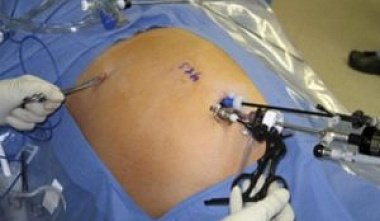
Laparoscopic treatment of the bile ducts and gallbladder
Gallstones can be found in either the gallbladder or the bile ducts. In certain situations, they can be removed without major, invasive surgery. Laparoscopic removal of the gallbladder and its stones is possible, as well as a choledochotomy performed using specialized instruments. This involves incising the common bile duct, inspecting its lumen, and, if stones are detected, removing them. Modern technology allows this to be accomplished with minimal trauma and maximum efficiency. There are also other methods for removing stones from the bile ducts, such as using a flexible fibrogastroduodenoscope. Many patients are familiar with this method today. It has much in common with standard fibrogastroscopy. However, in addition to this, an instrument is inserted through the fibrogastroscope channel to dissect the sphincter that closes the outlet of the common bile duct. After endoscopic dissection of the sphincter, the stones fall out of the bile ducts and enter the intestines, from where they are eliminated naturally. Unfortunately, this method cannot remove stones from the gallbladder itself. Therefore, if stones are present in the gallbladder, the second stage after freeing the common bile duct is laparoscopic cholecystectomy, which involves removing the gallbladder, the source of the stones. Both stages of the surgery are minimally invasive and carry minimal risk. Patients recover quickly after this approach. However, the doctors performing these surgeries must be highly qualified. Laparoscopic cholecystectomy is a common procedure, performed today in many city hospitals. However, these techniques were first mastered at the Pavlov State Medical University of St. Petersburg, and from there they were spread to other hospitals.


