

Laparoscopic gastric banding in the surgical treatment of morbid obesity
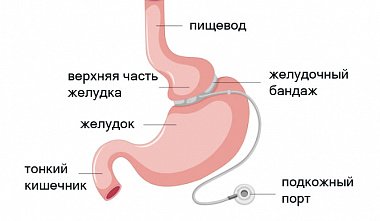
Various gastroplasty procedures are used to treat patients with morbid obesity. At our clinic, 22 patients (6 men, 16 women) underwent Kolle gastroplasty. The average body mass index was 46.4 ± 2.3 kg/m. Postoperative complications were identified in 5 patients. All were related to the negative mechanical impact of the prosthetic bands on the stomach. Given the significant mechanical impact of the synthetic prosthesis on the gastric wall, we collaborated with Ecoflon to develop a linear, non-adjustable polytetrafluoroethylene band with a unique fastener that allows for easy insertion and secure fixation during surgery. The connective tissue reaction developing around the polytetrafluoroethylene prevents band slippage. Good results, with a body mass index reduction of more than 15 kg/m, were observed in all patients. There was no deterioration in liver function or metabolic disorders. Improving the results of surgical treatment of patients with extreme obesity is also possible with the use of laparoscopic technology, which allows for a decrease in the invasiveness of surgical intervention. Since 1995, the clinic has been developing a laparoscopic version of the Kolle operation. To substantiate the method, topographic and anatomical studies and a series of experiments on animals were conducted. The objectives of the study were: - to study the topographic anatomy of the stomach and lesser omentum to select the safest sites for penetration into the cavity of the omental bursa; - to select the optimal points for trocar insertion; - to develop a technology for inserting a synthetic prosthesis and methods for its fixation; - to develop methods for controlling the diameter of the formed gastro-gastric junction and the volume of the newly created "small ventricle". In the experiment, various options for inserting the bandage, methods for its fixation, and ways to control the formed small ventricle were developed. The optimal option was recognized as one in which, after revision of the abdominal organs and retraction of the left lobe of the liver, the fundus of the stomach was mobilized from the angle of Hiss to the upper pole of the spleen using a retractor. The dissector was introduced into the cavity of the omental bursa through the avascular portion of the lesser omentum, either in the area of ??the quadrate lobe of the liver and the esophagogastric junction, or opposite the angle of the stomach. After reaching the superior gastropancreatic ligament, the dissector was secured by an assistant in the vestibule of the lesser omental cavity. The laparoscope was transferred to a trocar in the area of ??the left costal arch and advanced into the omental bursa. The fundus of the stomach was gradually moved toward the lesser curvature with clamps. The passage of the dissector through the gastropancreatic ligament was controlled through the laparoscope. The dissector grasped the prosthesis, previously inserted and positioned in the subdiaphragmatic space. The prosthesis was passed through the omental bursa. No difficulties were noted during prosthesis insertion. Various methods were used to form the small ventricle and secure the prosthesis. A belt-type fixation is preferred because it provides a secure fit. This type of fixation is simpler to perform, does not require additional sutures on the prosthesis, and holds it securely in the desired position. A disadvantage of this method is the use of a metal clasp, which can contribute to the formation of pressure ulcers in the gastric wall. The linear prosthesis, developed by us in collaboration with the company "Ecoflon", is securely fixed with an original clasp that can withstand pressure of over 200 mmHg. The diameter of the formed anastomosis was controlled using three different options. The best results were obtained using a predetermined bandage length with simultaneous control through a gastroscope. The bandage we developed can be fixed in three positions (4.5, 5, and 5.5 cm), which allows for the selection of the diameter of the formed anastomosis. Thus, the completed topographic, anatomical, and experimental studies made it possible to begin the clinical use of laparoscopic technology for the formation of a small stomach according to Kolle. Initial clinical experience forced us to slightly modify the bandage placement technique. The band is preferably passed through the gastropancreatic ligament, ensuring its permanent position. Passing the band through the omental bursa increases the risk of slippage, as there is no tissue in this area to support it. Tunneling sutures should be placed on the anterior and, if possible, posterior wall of the stomach to cover the band. When performing the Kolle gastric band, it should be understood that weight loss is directly related to the size of the created ventricle. Increasing the ventricle volume was associated with a smaller decrease in body mass index. When using laparoscopic technology, the band was positioned as high as possible on the stomach, with particular attention paid to the volume of the created ventricle during the placement of the tunneling sutures. The ventricle volume should not exceed 20 ml. Due to slow dilation of the gastric wall, its volume gradually increases over the two years following surgery to 50 ml. The initial experience with laparoscopic gastroplasty allows this method to be considered an alternative to the traditional, highly traumatic surgical option.


