

Surgical thoracoscopy. Sympathetic nervous system surgery.
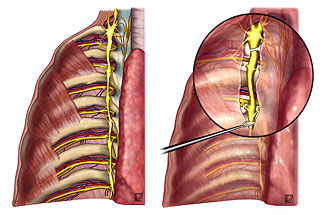
E.I. Sigal, R.G. Khamidullin Thoracic sympathectomy is one of the most frequently performed thoracic procedures. The small scope of the procedure and ease of execution are incomparable with the extensive chest trauma associated with traditional thoracotomy. Indications: - Raynaud's syndrome. - Hyperhidrosis. - Severe pain associated with advanced cancer of the upper abdominal organs (pancreas or stomach). Surgical technique. The surgery is performed under general anesthesia with separate bronchial intubation. It is possible to perform the surgery with the participation of both lungs in respiration, but in this case, an additional thoracoport is required for the insertion of a retractor for lung abduction. Typically, the surgery is performed through 2-3 approaches: a thoracoport for a thoracoscope is inserted into the 5th intercostal space along the midaxillary line, and instrumental thoracoports are inserted into the 2nd and 4th intercostal spaces along the midclavicular line. In the costovertebral angle, the sympathetic trunk is visualized, visible through the parietal pleura as a whitish cord. An electrocoagulation hook is used to incise the parietal pleura above the sympathetic trunk. For Raynaud's phenomenon and hyperhidrosis, the sympathetic trunk is isolated from the second to fourth ganglia and excised over a 5 cm length from the second to fourth intercostal spaces. For pancreatic and gastric cancer, the sympathetic trunk is removed from the seventh to eleventh intercostal spaces to relieve pain. The specimen is sent for histological examination. Electrocoagulation is used to destroy additional nerve fibers (incomplete transection of the sympathetic trunk has minimal effect), and hemostasis is achieved. The lung is inflated, the pleural cavity is drained, and drainage tubes are removed on the first day. Some surgeons prefer not to drain the pleural cavity during this procedure. Given the minimal trauma, simultaneous bilateral sympathectomy may be performed if indicated. In these cases, thoracoscopy is performed sequentially on one side, then the other. Complications and their prevention. A specific complication of intrathoracic sympathectomy is the development of Horner's syndrome due to excessively high sympathetic trunk resection (stellate ganglion removal).


