

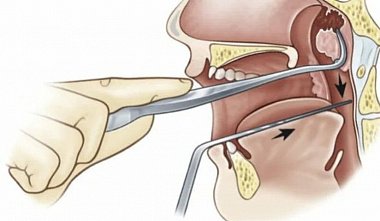
Features of the endoscopic adenotomy method
O.V. Mareev, A.V. Kazanova Saratov State Medical University Saratov, Russia The imperfection of the traditional adenotomy technique due to the lack of sufficient visual control during surgery with a wide variety of anatomy of the nasopharynx leads to incomplete removal of the pharyngeal tonsil. The aim of our study was to determine the advantages of endoscopic adenotomy. We observed 35 children aged 3 to 14 years, including 19 boys and 16 girls. All examined children underwent intraoperative control of adenoid removal using a 0° endoscope with a diameter of 3.0 mm. Adenoids were removed using a Beckman adenotome of 3 sizes with different curves of the working part of the adenotome. During the operation, attention was paid to the following features of adenoid vegetations: - location (in the vault of the nasopharynx, on the sides, in the orifice of the auditory tubes); - size (I degree, II degree, III degree); — weight in mg; — signs of inflammation (absent, present); — pathological examination data. The proliferation of lymphoid tissue in the nasopharyngeal vault was observed mainly in children who had not previously undergone adenotomy (36%); the location on the sides and in the orifice of the auditory tubes was noted in children who underwent repeated adenotomy (64%). All patients had an uneventful postoperative course. All children were discharged home in satisfactory condition under the supervision of an outpatient otolaryngologist. In the follow-up period of up to 1 year, no recurrence of adenoids was noted. Thus, the use of endoscopic adenotomy allows for complete visual control of the course of the operation and helps to optimize the results.


