

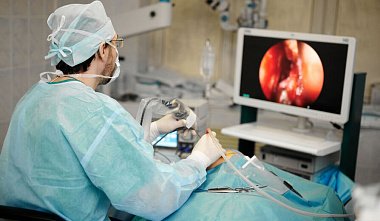
The use of argon plasma and radiosurgery in the treatment of chronic dacryocystitis.
Medical institution: Kazan State Medical Academy Kazan, Russia In recent years, endoscopic and/or microscopic methods of treating lacrimal duct pathology have become preferred due to a number of advantages over the external approach. At the same time, closure of the postoperative rhinostomy is typical for both the external and endonasal approaches when performing dacryocystorhinostomy. The aim of the study was to improve the results of microendoscopic shaver dacryocystorhinostomy (MESDCR). Material and methods. From 1998 to 2004, 227 MESDCRs were performed in 225 patients suffering from epiphora. The age of the patients ranged from 12 to 78 years. The diagnosis of nasolacrimal duct obstruction was confirmed by a number of objective examination methods. For surgical correction of the lacrimal ducts, modern equipment was used - endoscopes, a micro-light guide for diaphanoscopy through the lacrimal bone, the ELEPS shaver system with a cutter-suction attachment, a burr - attachments with large and small notches, diamond coating; curved scalpels, cutting-through forceps; radio wave surgical device "Surgitron ™" (frequency 3.8 MHz) and round loop electrodes with a thin arc of 6.35 mm in diameter, argon plasma coagulator; surgical microscope. The peculiarity of the intervention was the use of a shaver system providing adequate access to the lacrimal sac; formation of a window in the area of ??the medial wall of the lacrimal cell bone, including the frontal maxillary process of at least 12?5 mm in size; cutting out a U-shaped flap from the wall of the lacrimal sac using a radio wave; suturing; use of an endoscope at an angle of 70° for the best visibility in the area of ??the surgical field. Results. The results of dacryocystorhinostomy varied due to the improvement of the intervention technique and the experience gained by the rhinologist in performing the intervention. Thus, relapse of the disease in 2004 (44 operations) was not noted in any of the patients. Preoperative epiphora was eliminated, and The patency of the lacrimal drainage ducts was confirmed by irrigation of the lacrimal sac 2, 4, and 6 months after surgery, which was considered a successful outcome of the intervention. Conclusion. The formation of a persistent rhinostomy is apparently facilitated by: the size of the bone window corresponding to the size of the flap from the medial wall of the lacrimal sac; atraumatic formation of the flap from the lacrimal sac using a radio wave with an emphasis on its inferoposterior areas; suturing the marginal tissue of the lacrimal sac and the free edge of the nasal mucosa; clear indications for MESHDCR; adequate therapy of chronic dacryocystitis. V.N. Krasnozhen


