

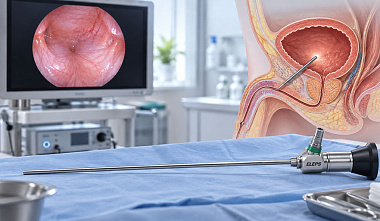
Diseases of the urinary system cannot always be accurately diagnosed based on test results or ultrasound findings. When a doctor needs to directly assess the condition of the urethra and urinary bladder, an endoscopic examination is performed.
What Is a Cystoscope Used For and Where Is It Applied?
A cystoscope is an endoscopic medical device designed for visual examination of the urethra and urinary bladder. A thin tube with an optical system is inserted through the urethra, allowing the doctor to view images of the internal surfaces on a monitor. Depending on its design and configuration, a cystoscope can be used for diagnostic examination, tissue sampling, ureteral catheterization, and certain minimally invasive procedures.
Modern cystoscopy allows the doctor to assess the condition of the mucous membrane directly during the procedure. The image can be displayed on a monitor, saved in a medical information system as a photograph or still image, and used for subsequent assessment of changes in the patient's condition.
Different types of equipment are used for different clinical purposes. They may differ in the design of the working section, diameter, length, optical system, presence of a working channel, and ability to connect to a video system.
Types of Cystoscopes
Different tasks in urology require appropriate equipment. Cystoscopes vary in design, optical characteristics, and instrument-handling capabilities and are selected according to the purpose of the examination and the nature of the planned procedure. The following types are distinguished:
-
A rigid cystoscope has a straight working section and a metal sheath. An optical system is located inside, and the design may include irrigation and instrument channels. Rigid models are used for diagnostic examinations and various endoscopic procedures.
-
A flexible cystoscope is equipped with a flexible insertion tube and a controllable distal tip. The doctor can change the direction of the tip during examination, allowing access to different areas of the urinary bladder.
-
Diagnostic cystoscopes are primarily designed for visual examination of the urethra and urinary bladder.
-
Operative cystoscopes have a working channel through which forceps and other specialized instruments can be inserted.
-
Catheterization cystoscopes are used to guide catheters into the ureters.
A separate group includes fibercystoscopes and videocystoscopes. In the first case, the image is transmitted through optical fibers, while in the second, it is generated by an electronic sensor located in the distal part of the device. The specific type is selected according to the intended use of the equipment and the requirements of the urology department.
ElePS is a Russian manufacturer of equipment, optics, and instruments for endoscopic surgery. The company's catalog includes rigid endoscopes for various applications, including cystoscopes, as well as equipment for creating a complete endoscopic system: endoscopic cameras, light sources and light guides, medical monitors, aspiration and irrigation systems, instruments, and other components.
When equipping a urology department, the compatibility of all system components must be taken into account. The cystoscope should be compatible with the selected optics and instruments, while the video camera, light source, and monitor should provide high-quality image acquisition and display. ElePS offers endoscopy equipment as an integrated technological system, simplifying the selection of equipment for the specific requirements of a clinic and the working practices of its specialists.
Cystoscope Design and Components
The design depends on the specific model, but a typical cystoscope consists of several functional components. The basis of a rigid design is the sheath, which contains the optical system. The endoscope is inserted through the urethra, providing access to the urinary bladder.
The optical unit is an important part of the system. Depending on the model, it may use a lens system or optical fibers for image transmission. Rigid cystoscopes may be equipped with optics providing different viewing angles, such as 0°, 12°, 30°, or 70°. Working length and diameter also vary. A common diameter for rigid optics is approximately 4 mm.
Flexible equipment has a controllable distal section, a handle with a deflection mechanism, and one or more channels. A specialized instrument can be inserted through the working channel, fluid can be supplied, or other manipulations provided by the design can be performed.
To obtain an image, the endoscope is connected to a light source and video system. With modern configurations, the device can transmit high-resolution images. The choice of components depends on the characteristics of the specific endoscope and the endoscopic tower being used.
After use, medical equipment undergoes the prescribed cleaning and sterilization procedures. The manufacturer specifies the permitted processing method for each model. After sterilization, the cystoscope must be properly dried and stored under the conditions specified in the instructions to maintain the functionality of its optical and mechanical components.
How a Cystoscope Works
The operating principle is based on transmitting an image from inside the urinary bladder through an optical system or electronic camera. Before the examination, the doctor prepares the patient and selects the appropriate type of endoscope. After the cystoscope is inserted through the urethra, the doctor examines the urethra and then the inner surface of the urinary bladder. To improve visualization, sterile solution may be introduced into the bladder. This expands the bladder walls, making it easier to assess the mucous membrane across the accessible surface.
Rigid optics produce an image according to the selected viewing angle. With a flexible endoscope, the direction of examination can additionally be adjusted by bending the distal tip. If necessary, an instrument can be passed through the working channel to perform a diagnostic or therapeutic procedure.
What Can Be Seen Using a Cystoscope
Endoscopic examination allows the doctor to directly assess the condition of the mucous membrane and anatomical structures. The examination may reveal:
-
inflammation and other changes in the mucous membrane;
-
areas of bleeding;
-
polyps and tumors;
-
bladder stones;
-
foreign bodies;
-
urethral strictures;
-
changes in the bladder walls;
-
pathological areas requiring further examination;
-
ureteral orifices and their anatomical features.
If the equipment is connected to a recording system, the doctor can save a photograph or video recording of a detected abnormality. A digital image is used to document the findings and compare them during subsequent examinations.
How Cystoscopy Is Performed
The specific technique depends on the patient's sex, the condition of the urinary tract, the purpose of the procedure, and the selected endoscope. In general, the examination includes the following stages:
-
Patient preparation. The doctor reviews the patient's complaints, medical history, test results, and previous examinations.
-
Equipment selection. The type of cystoscope, required optics, and additional instruments are selected.
-
Anesthesia. Depending on the situation, local anesthesia or another method of pain management may be used.
-
Endoscope insertion. The sterile device is carefully passed through the urethra into the urinary bladder.
-
Bladder filling. If necessary, sterile solution is introduced to improve visualization.
-
Examination. The doctor systematically examines the urethra and the inner surface of the bladder.
-
Additional procedures. If indicated, specialized instruments can be inserted through the working channel, for example, to collect a tissue sample.
-
Completion of the procedure. The endoscope is removed, after which the specialist provides the patient with recommendations.
In women, the urethra is shorter than in men, so the insertion of the endoscope has certain technical features. In all cases, the doctor takes into account the patient's anatomy and the characteristics of the device being used.
Indications and Contraindications for Cystoscopy
Cystoscopy is prescribed when it is necessary to determine the cause of urological symptoms or obtain information that cannot be obtained through standard examinations.
Main indications:
-
blood in the urine;
-
painful or difficult urination;
-
recurrent urinary tract infections;
-
suspected pathological changes in the urinary bladder;
-
masses or abnormalities detected during other examinations;
-
the need to determine the cause of urological disorders;
-
the need for a biopsy;
-
performance of certain endoscopic procedures.
Possible contraindications include:
-
acute inflammation of the urethra;
-
active urinary tract infection;
-
severe general condition of the patient;
-
significant coagulation disorders associated with an increased risk of bleeding;
-
conditions in which the procedure cannot temporarily be performed.
The final decision is made by the doctor after assessing the patient's condition. The list of restrictions may differ for diagnostic and operative cystoscopy.
Cystoscope Capabilities in Diagnosis and Treatment
A modern cystoscope is part of an endoscopic system whose capabilities are determined by its design and the installed components. A diagnostic model provides the doctor with visual access to the urethra and urinary bladder. An operative endoscope additionally allows specialized instruments to be passed through a working channel. With the appropriate configuration, a single procedure can include visual examination, tissue sampling for histological analysis, removal of a small lesion, or extraction of a foreign body. Certain models are used to guide catheters into the ureters.
When selecting equipment for a clinic, factors such as diameter and working length, viewing angle, type of optical system, presence and diameter of the working channel, image transmission quality, sterilization capabilities, and compatibility with other components of the endoscopic system are taken into account.
ElePS offers medical endoscopic equipment for diagnostic and surgical departments. When selecting a cystoscope, the intended use of the equipment, the specifications of the particular model, and the requirements of the compatible endoscopic system are taken into account. For urology departments and operating rooms, ElePS offers eq


