

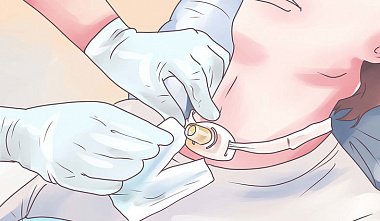
Removal of foreign bodies from the respiratory tract through an end tracheostomy
The problem of foreign bodies in the respiratory tract in adults can be classified as casuistic due to the rarity of such observations (Debeljak A. et al., 1999). In most cases, due to the variety of instruments developed for fiberoptic endoscopes, foreign bodies in the trachea and bronchi can be successfully removed using a fiberoptic bronchoscope, but there are foreign bodies that can only be removed with a rigid bronchoscope (Ikeda M. et al., 1996). Observations have been described where, due to technical difficulties, it was necessary to resort to a combination of rigid bronchoscopy and tracheostomy (Ohkouchi Y. et al., 1992) and even thoracotomy (Finkelstein, D. M. et al., 1989) to remove a foreign body. A comparatively higher risk of foreign body aspiration exists in patients with tracheostomies, who are forced to constantly wear and care for the cannula. The literature has repeatedly described cases of aspiration of Montgomery-type T-shaped tracheostomy tubes (Zulueta J. J. et al., 1992), fragments of damaged metal and plastic tracheostomy tubes (Otto R. A. et al., 1985; Gupta S. C., 1987; Ming C. C. et al., 1989; Majid, A. A., 1989; Wetke, R. et al., 1991; Bhattacharjee N., 1994; Erdozain Rodriguez I. et al., 1998), connectors (Lawton M. B. et al., 1987; Shinkwin C. A. et al., 1992) and other accessories (Nicolaides, A. R., 1990; Bhargava S. K. et al., 1993). Typically, removal of such foreign bodies by standard rigid bronchoscopy with additional access to the tracheal lumen through an existing tracheostomy presents no difficulties. Moreover, there are principled advocates of removing large tracheal foreign bodies through a tracheostomy to avoid damage to the relatively delicate structures of the larynx (Ohkouchi Y. et al., 1992). In patients who have undergone laryngeal extirpation with end tracheostomy, the configuration of the trachea is significantly altered, as a result of which intubation with a rigid bronchoscope tube with a diameter sufficient for passing forceps is not always technically feasible. Attempts to remove the foreign body blindly are fraught with damage to the trachea and main bronchi. On the other hand, large foreign bodies in the trachea and main bronchi are associated with the risk of acute respiratory failure. If, under these conditions, the foreign body cannot be removed either through a rigid tube or by means of a fiberoptic bronchoscope, the situation becomes dangerous. We present three cases of successful removal of large foreign bodies from the respiratory tract in patients with end tracheostomies, which were encountered in our practice over a relatively short period of six months. 1. Patient V., 55, who underwent laryngeal extirpation for cancer in 1998, aspirated a cotton swab on February 14, 2000, with which he independently cleaned his tracheostomy. He was brought to the emergency department by the intensive care team. Fiberoptic bronchoscopy through the tracheostomy visualized the cotton swab completely obstructing the lumen of the left main bronchus. The foreign body was removed using biopsy forceps of the fiberoptic bronchoscope. The patient refused the proposed hospitalization for observation and went home. 2. Patient H., 80, was admitted by ambulance on September 22, 1999. In 1998, he underwent laryngeal extirpation and end tracheostomy for laryngeal cancer. On September 22, 1999, he cleaned the tracheostomy cannula without removing it from the fistula, resulting in aspiration of the synthetic wire brush. A chest radiograph and subsequent fiberoptic tracheoscopy revealed a foreign body in the lumen of the lower trachea. An attempt to remove the foreign body using biopsy forceps from a fiberoptic bronchoscope was unsuccessful and resulted in its migration into the left main bronchus. Attempts to grasp the foreign body with a wire loop and a Dormia basket were also unsuccessful, as the end of the brush handle became embedded in the wall of the left main bronchus near the ostium. An attempt to intubate the trachea through the tracheostomy with a Friedel No. 8 rigid bronchoscope failed to visualize the foreign body due to the curvature of the trachea and was also accompanied by severe contact bleeding of the mucosa, obstructing visibility. Given the absence of signs of acute respiratory failure, attempts to remove the foreign body were temporarily discontinued at this stage. On September 23, 1999, Storz optical alligator forceps were inserted into the tracheal lumen through the tracheostomy, with which the foreign body was removed from the left main bronchus within a few seconds. Given the prolonged (more than 24 hours) presence of a foreign body in the respiratory tract, a 5-day course of antibacterial and inhalation therapy was administered, after which the patient was discharged home. 3. Patient K., 55, who underwent laryngeal extirpation for cancer in 1998, independently sanitized his tracheostomy with a textile napkin and aspirated it on March 5, 2000, on the way to his next radiation therapy session. He was admitted to the intensive care team with complaints of inspiratory dyspnea. An objective examination revealed signs of stage II acute respiratory failure, dyspnea at rest, and orthopnea. The ENT physician on duty attempted tracheal intubation with an esophagoscope tube, which was unsuccessful due to a tracheal curvature. Fiberoptic tracheoscopy visualized a textile napkin almost completely obstructing the lumen of the lower trachea. Immediately afterward, Storz optical alligator forceps were inserted into the tracheal lumen through the tracheostomy, and the foreign body was removed within seconds. Immediately after removal of the foreign body, signs of respiratory failure resolved, and the patient declined hospitalization for observation and continued on to radiation therapy. Objectives of the demonstration: - to highlight the increased risk of foreign body aspiration in patients with a tracheostomy; - to demonstrate the utility of optical forceps for removing airway foreign bodies in the absence of a larynx.


