

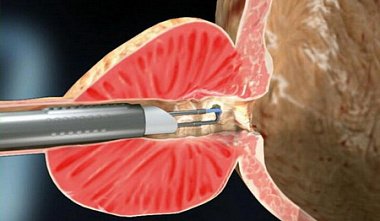
The world's best laser for treating prostate adenoma has been developed in Russia.
28.04.2017 11:19:00
A unique device was jointly developed by doctors and engineers. "And on the second day, the person gets up and goes home..." began Dmitry Yenikeyev, a surgeon and recently deputy director for research at the Uronephrology Research Institute of the First Medical University. It was hard to believe... I remember how my grandfather, a front-line soldier, suffered, how he could barely contain his groans and cried, turning away from his loved ones. I remember many other stories. Prostate adenoma is one of the most common "male" diseases. Yenikeyev confirms this with figures: a third of patients in any urology department are treated for adenoma. Yes, this tumor is benign. But as it grows, it compresses the urethra and can eventually lead to severe urinary retention—an inability to urinate. Hence the pain and tears... A difficult operation. It is believed that a normal prostate gland—also known as the prostate—is about the size of a walnut. But as the tumor—the adenoma—grows, it gradually compresses the canal," explains Yenikeyev. "If the tumor is smaller than 80 cubic centimeters, we perform endoscopic surgery—it's not traumatic. We use an electrical loop and gradually cut away the tumor. But if the tumor is larger, we used to operate open. It's a major operation with large incisions, drains, and general anesthesia. Afterward, the patient is bedridden for two to three weeks. Tubes run from them... This is still the method used in many Russian clinics. But five to seven years ago, imported laser systems began appearing in urology hospitals across the country, allowing adenomas of any size to be removed endoscopically with minimal bleeding. Surgeries began to be performed in a completely different way... "We were the first in Russia to use an Israeli laser. That was back in 2010," explains Yenikeyev. "It allows us to enucleate the tumor rather than cut it layer by layer. And there are no incisions in the skin." And the anesthesia is easier—an injection is given in the back, the patient remains conscious, and can speak with the doctors during the surgery. They simply experience decreased sensation below the navel for 4-6 hours. If the story of adenoma treatment at the First Medical Center's urology clinic ended there, it wouldn't be worth writing. These lasers are now used more or less successfully in various clinics. But this story has an unexpected twist. The doctors were given a foreign laser, the latest in medical technology. The surgeons mastered the operation with it. What more could they want? And here it becomes clear that a modern, talented doctor isn't someone who stands in the operating room like a production line. They need to understand how to make the surgery more successful and how to minimize the patient's suffering. The doctors at the urology clinic weren't entirely satisfied with the imported laser. The laser team: "We needed a more advanced instrument, more powerful. And cheaper," says Dmitry. "The fibers through which the beam is delivered in foreign lasers are very expensive." One fiber costs about a thousand dollars. Other consumables are also incredibly expensive. Moreover, learning to operate them is not easy. In some clinics, these lasers are simply covered in dust. There's no one to operate them—training is long and difficult. Doctors at First Medical University took a non-trivial approach. Rector Petr Glybochko supported the creation of a special "laser group." The surgeons turned to the IRE Polyus scientific and technical association, which develops and manufactures industrial lasers. And in just a year and a half, a domestic device was ready. A year and a half! (And they say we've fallen behind global technology leaders and it's easier for us to buy foreign equipment and be as happy as Papuans with beads and mirrors.) In fact, the Soviet Union was initially a leader in laser technology development. Our physicists Alexander Prokhorov and Nikolai Basov built the world's first laser system. For this, they received the Nobel Prize in 1964! The third nominee was American scientist Charles Townes. He was conducting research alongside Prokhorov and Basov, unaware of their work, but the military immediately set its sights on the laser. Valentin Pavlovich Gapontsev, founder of the IRE Polyus association, is today one of the most renowned laser specialists. His name is included in the list of 28 outstanding world scientists in the field of laser physics, engineering, and technology. Gapontsev leads enterprises and research centers in Russia, the USA, Germany, and Italy. "The engineers came to the clinic and observed the surgeries," continues Dmitry Enikeev. "We discussed the smallest details—what the display should be like to make it easy for us to work, the best arrangement of the buttons. Ultimately, the first Russian surgical laser rolled into the operating room on Bolshaya Pirogovskaya Street. It weighs only 40 kg—imported devices are almost three times heavier. And yet, they are three times more expensive than ours! Training to operate our laser takes just a week. The device runs on a regular outlet; it can be plugged in like a kettle. The "foreigners" were "chained" to special outlets, making it impossible to transport them from one operating room to another. Moreover, the fibers for it will be manufactured in Russia. And in Kazan, they are also setting up production of a special surgical instrument for urological procedures using the new laser. "We'll operate on everyone who needs it." Not long ago, a European Congress of Urologists was held in the UK. Dmitry Enikeev and his colleagues sent a video of a surgery performed with the new laser to the organizing committee. He was invited to present a paper. It should be noted that about five and a half thousand applications were submitted to the congress. Several dozen of the most groundbreaking papers were selected. In May, doctors from the First Medical Urology Clinic will travel to Boston, USA, to present the new surgical technology. After hearing this remarkable story, I asked to see the miracle device. They dressed me in a blue sterile gown, put a cap on my head, and Enikeev and I went into the operating room. The laser was mounted on a mobile table. White plastic, blue buttons. Yenikeyev carefully ran his fingers over the body: "This is the first one. But this alone isn't enough for us." Almost 150 operations have already been performed using the new laser. Three surgeons working in three departments of the clinic have mastered it. Then we went to the ward of the patient Yenikeyev had operated on just that morning. The man was watching TV and looked quite cheerful. "We'll remove the catheter this evening and send him home tomorrow. He'll need to come back to see us a couple more times. And that's it," the surgeon explains. "All this is great, of course," I say. "But I'll write about the new technology. It's clear that many patients with prostate adenoma won't want to go under the knife of a local surgeon. They'll dream of coming to you... But how?" "It's not difficult to get treatment with us," adds Professor Leonid Rapoport, Deputy Director for Clinical Work at the Uronephrology Research Institute, with optimism. "We're a federal medical institution." We perform surgeries for Russian citizens free of charge, within the Ministry of Health's quotas. You need to consult with our doctor and get on a waiting list. Yes, sometimes there's a bit of a wait. But we operate on everyone. And if it's an emergency, we give surgeries out of turn. "And you can help everyone who comes in?!" "Our clinic performs up to twenty such surgeries a week. We're expecting a second laser in May, and then we'll be able to increase our intake."


